
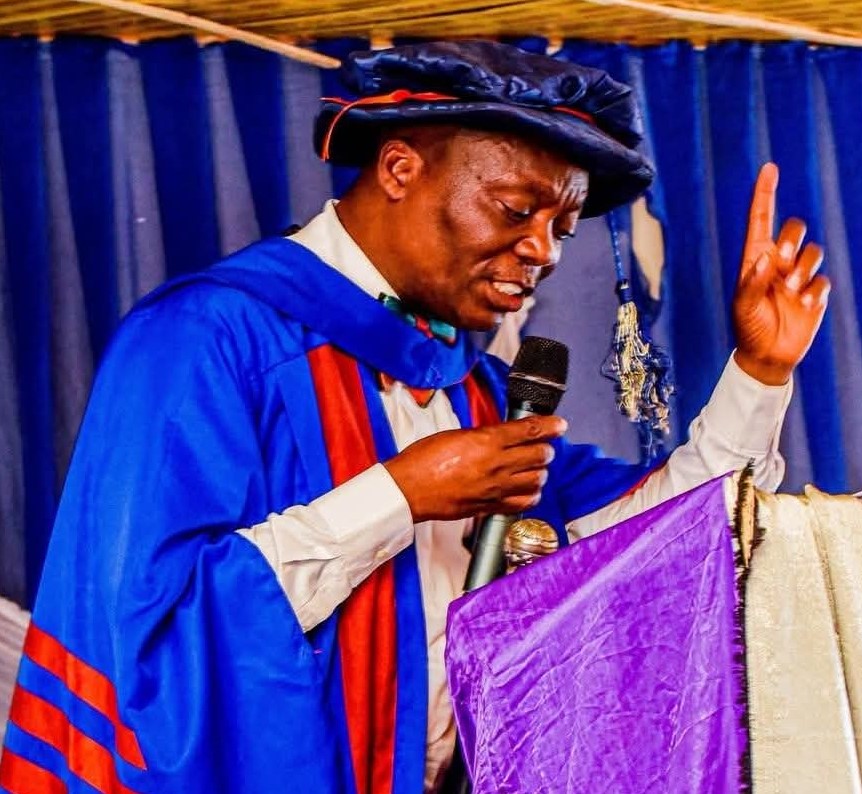
The Director-General of the Ekiti State Bureau of Tourism Development, Barrister Wale Ojo-Lanre, has charged newly admitted students of the International Institute of Journalism, IIJ, Ekiti State Campus, to distinguish themselves from the growing army of untrained citizen reporters by embracing development journalism as a responsible professional pathway.
Ojo-Lanre gave the charge while delivering the matriculation lecture titled “Development Journalism: The Responsible Pathway for Rookie Journalists in the Age of Phone Journalism” at the matriculation ceremony of the institute in Ado-Ekiti.
He said journalism was passing through one of the most dramatic revolutions in human history, noting that the mobile phone had become both a blessing and a danger to truth.
According to him, the rise of citizen journalism has created a situation where anybody with a phone, data bundle and a smattering of English can post, report, accuse, mislead, praise, condemn or destroy reputations in the name of journalism.
He warned that while technology has democratised access to publication, it has also opened the public space to reckless posting, fake news, blackmail, propaganda, rumour and unethical communication.
Ojo-Lanre said the challenge before rookie journalists was to prove that journalism is not noise, abuse, gossip, social media excitement or reckless publication, but a disciplined public service built on ethics, verification, fairness, balance and public interest.
He told the students that one of the most reliable ways to stand apart in the crowded media space was to embrace development journalism, which he described as journalism with depth, context, conscience and public purpose.
“Development journalism is the journalism of social progress. It focuses on the welfare of the people, the growth of communities, the performance of institutions and the transformation of society. It does not merely report events; it interrogates their meaning and impact on the people,” he said.
Ojo-Lanre explained that development journalism compels journalists to go beyond surface reporting by asking deeper questions about policies, projects and public programmes.
He said a development journalist must not merely report that a road has been built, but must ask who will use the road, how it will affect farmers, traders, students and patients, whether it will reduce transport costs, whether the community was involved and whether there is a maintenance plan.
Similarly, he said a development journalist must not only report the commissioning of a hospital, but must investigate whether there are doctors, nurses, drugs, electricity, affordability and real benefits to the people.
The former Nigerian Tribune journalist and one of the pioneer students of IIJ, Ibadan Campus, recalled his own professional journey, saying he enrolled at the institute in 1997 despite already holding a degree in History and pursuing a Master’s degree.
He said the experience taught him that writing and journalism are related but not the same, stressing that professional training remains the dividing line between ordinary writing and responsible journalism.
Ojo-Lanre narrated how, during a professional registration exercise by the Nigerian Union of Journalists in Oyo State, he was told that despite being a fine writer and media practitioner, he was not qualified to be registered as a professional journalist because he had not received formal journalism training.
He said the humbling encounter pushed him to seek admission into IIJ, where he submitted himself to professional training and discipline.
“That experience taught me a lesson I will never forget. A writer may impress, but a journalist must verify. A writer may entertain, but a journalist must inform. A writer may provoke, but a journalist must be responsible. A writer may depend on flair, but a journalist must depend on facts, fairness, ethics, balance and public interest,” he said.
He congratulated the matriculating students for choosing to pass through the furnace and rigour of professional journalism training, noting that their admission into IIJ marked the beginning of their transformation from ordinary writers, commentators, social media enthusiasts and public analysts into trained and certificated journalists.
Ojo-Lanre said the ability to speak good English or write beautifully does not automatically make anyone a journalist, just as fluency in legal language does not make anyone a lawyer without passing through the discipline of legal training and Law School.
He noted that influence, social media followership and visibility should never be mistaken for professional competence.
He said, “A phone is not a newsroom. A phone is only a tool. A phone does not teach ethics. It does not teach balance. It does not teach verification. It does not teach media law. It does not teach fairness. It does not teach public interest. That is why professional training is important.”


