
Following the increasing attacks on African migrants, particularly Nigerians, Industry Professionals have attributed these incidents to poverty and a lack of education among some South African citizens. In recent times, the crime rate in South Africa has risen, with some citizens accusing migrants of being responsible for criminal activities in the country. This perception has contributed to the growing wave of xenophobic attacks, which have increasingly evolved into acts of Afrophobia.
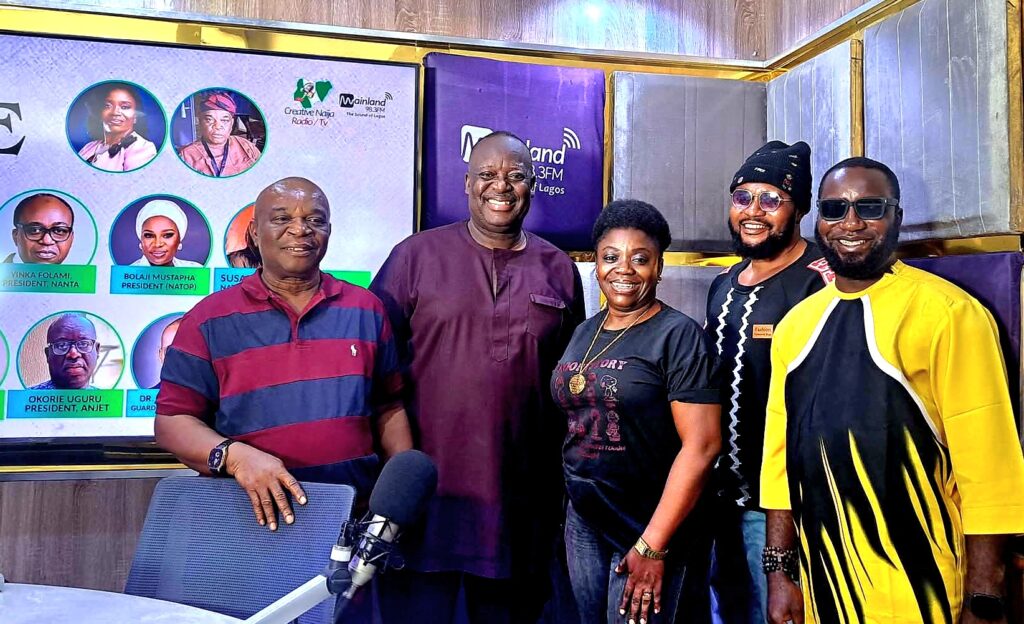
The issue was extensively discussed at Villa Square, a special segment of Cr8tive 9ja, a weekly tourism and cultural magazine programme aired every Thursday on Mainland 98.3 FM, Lagos. The programme, anchored by renowned tourism journalist Frank Meke alongside Bunmi Bade Adeniji, focused on the topic: “Afrophobia: A Threat to Africa’s Unity, Trade, and Tourism.”
Speaking through a telephone interview from Abuja, Susan Akporiaye, National Deputy President of the Federation of Tourism Associations of Nigeria (FTAN), emphasized the need for Africans to promote unity and mutual respect. She noted that both Nigerians and South Africans share responsibility in addressing the issue.
“We should not ignore our own faults,” she said. “From my findings and investigations through sources in South Africa, I was informed that some Nigerians from the Igbo community installed a king in Durban, known as the Eze Ndi Igbo Durban. South Africans highly respect their traditional Zulu King, and according to their customs, only one king is recognized. Many Zulu people perceived this as an attempt to interfere with their culture.”
Akporiaye stressed the importance of African countries working together toward shared goals. She also called on South African President Cyril Ramaphosa to openly condemn Afrophobia, as well as the destruction of property and killings of fellow African nationals in South Africa.
Also speaking, Okorie Uguru, President of the Association of Nigerian Journalists and Writers of Tourism, attributed the profiling of Africans in South Africa to ignorance and lack of education.
“When people are judged based on tribe, nationality, or religion, it is wrong and unacceptable in any responsible society,” he said. “As travellers, we have discovered that it is unfair to stereotype an entire group of people because of the actions of a few individuals.”
One of the guests, Bolaji Seun, a Youth tourism enthusiast who has travelled around the African continent also highlighted the importance of African unity and regional integration. “I do not understand why Africans find it difficult to remain united,” he said. “For example, when travelling within countries under the Economic Community of West African States (ECOWAS), travellers still face unnecessary immigration bottlenecks and unofficial charges for passport stamping, which should not be the case.”
Seun further shared that a South African acquaintance once told him her negative perception of Nigerians stemmed from a personal emotional experience involving romance relationship gone sour with a Nigerian man. According to Bolaji Seun such experiences often contribute to generalized stereotypes against Nigerians in South Africa.
Dr. Wole Oyebade, a member of the Guardian Editorial board who spoke from South African, blamed the Political tension in South Africa, stating that the coming elections and political tension have contributed to the situation. He said that the oppositions are blaming the immigration policies of the current administration as a major contributor to the increasing crime rate in South African.
“For the African continent, they are of the opinion that the, Xenophobia attacks have become a reoccurring situation in South Africa, we realize if the government can discourage this attack and insist things are done the normal way, things might change” Dr. Oyebade noted.
Nkereweum Onung, the Chairman, Nigeria Hospitality and Tourism Sector Skills Council, blamed envy for the rising attacks on Africa immigrants in South-Africa. He stated that such situation is destroying the African Unity, and progress of the continent. He also attributed the issue to the increasing poverty in South-Africa stressing that the government should speak to the citizens and educate them. “The South-Africans might be on the losing side with over 25% of their investment in foreign countries like the MTN, DSTV, Shoprite and others, this continuous attack will affect them on a long run” he said.
The President of the Nigeria Association of Tour Operators, Bolaji Mustapha, stated that the persistent attacks have negatively affected trade and tourism across Africa.
“For tourism, many Africans are now more reluctant to visit fellow African countries and instead head to destinations in Europe or Asia because of developments in South Africa and visa restrictions across the continent,” she said. “As tour operators, we are working to promote intra-African tourism, but these incidents send the wrong message to potential travellers.”
Mustapha added that her association had advised tour operators to suspend the promotion of South African tour destinations until the safety of foreign nationals can be guaranteed.
“We do not want to expose tourists to danger, despite South Africa’s efforts over the years to market its tourism sector,” she said, while urging the South African government to take decisive action to protect foreign nationals living in the country.
In his remarks, Frank Meke, Chief Executive Officer of Cr8tive 9ja Media, said Africa is currently facing a critical moment, with the international community closely observing developments on the continent.
He called on African leaders to handle the issue with caution and urgency in order to preserve African unity, regional cooperation, and economic growth.
Over the years, Xenophobia attacks have been carried out on Nigerians in South Africa, but a recent trend has emerged with the Afrophobia attacks. The Afrophobia is a form of racism, prejudice, and discrimination specifically targeting Black people and people of African descent. It involves dehumanizing attitudes, systemic discrimination, and violence including hate speech and crimes rooted in stereotypes of “inferiority” or “incompatible difference.
The South African Economy in the last five years has witnessed a sluggish growth from (2021 – 2025). In 2023, the country suffered a 0.8% decline, and in 2025, a 1.1% decline in GDP. The country’s unemployment rate remained consistently high, with the official rate rising to 32.9% in Q1 2025. The Country has enjoyed good business relationship with Nigeria as key of her establishment are domiciled in Nigeria like MTN, DSTV, Standard Chacter Bank among other businesses.
Some Nigerians are of the option that if the South African government fails to handle the issue and strongly condemn the Afrophobia attacks, some countries might as well send their South African Nationals packing.


